Tuesday, November 14, 2006

Interesting Facts About F1 Cars

Here's some information for all those F1 crazy people out there..!!

for more visit the formula1 website..


**F 1 is not only just F1

F1 car is made up of 80,000 components, if it were assembled 99.9% correctly, it would still start the race with 80 things wrong!

When an F1 driver hits the brakes on his car he experiences retardation or deceleration comparable to a regular car driving through a BRICK wall at 300kmph!!!

F1

F1 car can go from 0 to 160 kph AND back to 0 in FOUR seconds!!!!!!!

F1 car engines last only for about 2 hours of racing mostly before blowing up on the other hand we expect our engines to last us for a decent 20yrs on an average and they quite faithfully DO….thats the extent to which the engines r pushed to perform…

F1 Pictrue

An average F1 driver looses about 4kgs of weight after just one race due to the prolonged exposure to high G forces and temperatures for little over an hour (Yeah thats right!!!)

At 550kg a F1 car is less than half the weight of a Mini.

F1 Pictrue

To give you an idea of just how important aerodynamic design and added down force can be, small planes can take off at slower speeds than F1 cars travel on the track.

Without aerodynamic down force, high-performance racing cars have sufficient power to produce wheel spin and loss of control at 160 kph. They usually race at over 300 kph.

F1 Machine

In a street course race like the Monaco grand prix, the down force provides enough suction to lift manhole covers. Before the race all of the manhole covers on the streets have to be welded down to prevent this from happening!

The refuelers used in F1 can supply 12 liters of fuel per second. This means it would take just 4 seconds to fill the tank of an average 50 liter family car. They use the same refueling rigs used on US military helicopters today.

F1 Car

TOP F1 pit crews can refuel and change tyres in around 3 seconds. It took me 8 sec to read above point

During the race the tyres lose weight! Each tyre loses about 0.5 kg in weight due to wear.

F1 Image

Normal tyres last 60 000 - 100 000 km. Racing tyres are designed to last 90 - 120 km.

A dry-weather F1 tyre reaches peak operating performance (best grip) when tread temperature is between 900C and 1200C.(Water boils boils at 100C remember) At top speed, F1 tyres rotate 50 times a second.

**.. received as a fwd**

Saturday, September 30, 2006

It Happens Only In India

Scenario 1
Two guys are fighting and a third guy comes along, then a fourth and they start arguing about who's right.
You are in Kolkata

Scenario 2
Two guys are fighting and a third guy comes along, sees them and walks on.
That's Mumbai

Scenario 3
Two guys are fighting and a third guy comes along & tries to make peace.The first two get together & beat him up.
That's Delhi

Scenario 4
Two guys are fighting. A crowd gathers to watch. A guy comes along And quietly opens a chai-stall
That's Ahmedabad.

Scenario 5
Two guys are fighting and a third guy comes he writes a software program to stop the fight. But the fight doesn't stop b'cos of a bug in the program.
That's Bangalore

Scenario 6
Two guys are fighting. A crowd gathers to watch. A guy comes along and quietly says that "AMMA" doesn't like all this nonsense. Peace comes in.
That's Chennai.

Scenario 7
Two guys are fighting. Third guy comes along with a carton of beer. All sit together drinking beer and abusing each other and all go home being friends.
You are in Goa

Scenario 8
Two guys are fighting. Both of them take time out and call their friends on mobile. Now 50 guys are fighting.
You are DEFINITELY IN Punjab!

haha.. All Characters...!!

Sunday, September 17, 2006

The Speed King..!!

MICHAEL SCHUMACHER


Nationality: German

Teams: Benetton and Ferrari

Total number of races: 247

F1 debut: Belgian Grand Prix in 1991.

First victory: Belgian Grand Prix, 1992.

World Championships: 7 (1994, 1995, 2000, 2001, 2002, 2003, 2004) — a world record. Broke Juan Manuel Fangio's record of five in 2003.

Most GP victories: 90 (Previous best: Alain Prost 51)

Most victories with one team: 71

Most podiums: 153 (Previous best: Alain Prost 106)

Most points in a season: 148 in 2004. (Previous best: Nigel Mansell 108 in 1992)

Most wins in a season: 13 in 2004 (Previous best: Nigel Mansell 9 in 1992)

Most 2nd place finishes: 43

Most pole positions: 68 (Previous best: Ayrton Senna 65)

Most fastest laps: 75 (Previous best: Alain Prost 41)

Most race wins from pole position: 40

Most career points: 1,354 (Previous best: Alain Prost 798.5)

(All records up to the Italian Grand Prix, 2006)

SCHUMI DOSSIER

GREAT MOMENTS:

1994: Wins his first World Championship title with Benetton.

2001: Posts his 52nd career victory at the Belgian Grand Prix to break Alain Prost's world record of 51 wins.

2002: Achieves most podium finishes in a season - 17.

2003: Wins his sixth World Championship to break Argentinian Juan Manuel Fangio's mark of five titles.

2004: A slew of records. Wins most championship titles (7), most consecutive championship titles (5) and most races in a season (13 out of 18 races). He also posts the best winning run in a season _ seven (European GP, Canadian GP, United States GP, French GP, British GP, German GP, Hungarian GP), and most championship points in a season: 148.

2006: Becomes the only driver to win five times at Indianapolis. Also becomes the only driver to win the French Grand Prix at Circuit de Nevers Magny-Cours eight times.

MOMENTS TO FORGET:

1994: With the World Championship at stake, Schumacher, in a Benetton, runs into Damon Hill's Williams. The incident sends both cars out of the race. Though the German won his first world title, he came in for heavy criticism.

1997: In the decisive European Grand Prix in Jerez, Spain, Schumacher attempts to run Jacques Villeneuve of Canada, his main rival for the title, off the track. However, he ends up in the gravel and Villeneuve wins the title. Later, FIA strips Schumacher of all his points and the second place finish.

1998: Jams and runs David Coulthard of McLaren out of the lead at the Argentinian GP. Surprisingly he escapes punishment.

2002: Is booed by the crowd at the Austrian GP after he passes team-mate and race leader Rubens Barrichello following team orders.

2006: In an attempt to win the pole position at the Monaco GP in Monte Carlo, he brings his Ferrari to an abrupt halt and disrupts the final qualification round. He is penalised and forced to start from the back of the grid for the race.

Source: The Sportstar


Thursday, June 29, 2006

Things we dont know.......

Well here is a video with some interesting info...
PS: Check out fot the spelling errors...!!

Monday, June 12, 2006

Soccer Blooper...

Well here is a video which makes u laugh at the clumsy mistakes, blunders and bungles made by players...

Thursday, June 08, 2006

Let The Games Begin....


On The Big Stage

In view of the World cup 2006

Sportstar Vol 29: June 10,2006

The World Cup provides the scope for players to display their talentson the HIGHEST STAGE. ANDY HAMPSON looks at the potential stars — youngsters and veterans alike — of Germany 2006.

RONALDINHO

Few doubt he is the best player in the world. The Barcelona star captured worldwide attention at the last World Cup but has gone on to become an even better player and looks destined to join the likes of Pele and Diego Maradona as a legend of the game. A wonderfully-gifted footballer, Ronaldinho is technically brilliant. He allies his flicks and tricks with a deadly attacking intent and is just about the most feared player on the planet.

He has pace, great vision and a strong finish — and such is Brazil's vast array of attacking talent that Ronaldinho is virtually impossible to contain. Any defence focusing too much on stopping him could do so at their peril — with the likes of Ronaldo, Kaka, Adriano and Robinho creating a mouth-watering forward line.

Born Ronaldo de Assis Moreira, he is better known as Ronaldinho — which means little Ronaldo to distinguish from his team-mate. He will be 26 by the time of the tournament and nearing the peak of his powers. He has already won one World Cup but could step up and be the real star of this one. There are certainly few experts looking beyond his team to win it again.


MICHAEL BALLACK

Attacking midfielder Ballack carries the host nation's hopes into the tournament. The Bayern Munich lynchpin, who has been linked most feverishly with Chelsea, is perhaps the one truly world-class player in the German ranks.

Ballack began his professional career with Kaiserslautern before catching the eye in Bayer Leverkusen's run to the Champions League final in 2002. He moved to Bayern the following summer and has been their captain for the past two years.

He is a highly versatile player, who — although most comfortable directing affairs and getting forward from central positions — is equally adept defensively. With his Bayern contract coming to an end, it remains unclear where the 29-year-old will play next. But his summer World Cup role is already well defined.

Germany have some good young players coming through, and Ballack is the figure to guide them. He has been a regular international for the past seven years and is the man Juergen Klinsmann will build his side around. He and Oliver Kahn dragged an otherwise mediocre Germany to the 2002 final, but they are certainly a better team now. With Ballack pulling the strings, the home fans have a right to feel confident.


DAVID VILLA

Diminutive Spanish striker Villa has been a big hit since Valencia took a gamble to buy him from Real Zaragoza for GBP 8 million last summer. The quick, skilful forward won the Copa Del Rey with Zaragoza in 2004 after joining them the previous year from Sporting Gijon.

Plying his trade at the Mestalla, where he has settled in seamlessly, Villa has attracted the attention of Spain coach Luis Aragones. His form this season has been better than that of Spanish stalwarts Raul, Fernando Torres and Fernando Morientes — but whether Aragones bows to public pressure and gives Villa a starting role remains to be seen.

The 24-year-old has fulfilled his potential since joining Los Che, fitting in perfectly with Quique Sanchez Flores' style of play, with old-fashioned wingers given the freedom to get forward and Argentinian play-maker Pablo Aimar operating behind him.

Villa is as equally capable of scoring instinctive, poacher's goals as he is of striking spectacularly — which seems to have become a habit. His winner at home to Deportivo La Coruna this season — when he spotted goalkeeper Jose Molina out of his goal and netted from the halfway line — was especially eye-catching.

Former Valencia boss Rafael Benitez had been keen to take Villa to Liverpool.

LIONEL MESSI
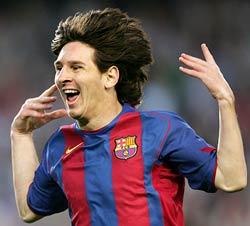
The 18-year-old rising star of Argentinian football has made quite a name for himself after breaking into the Barcelona first team over the past year. Messi moved to Barcelona with his parents at the age of 11, initially to seek treatment for a hormone deficiency. His footballing talent soon became obvious, and he was on the books of Barcelona from the age of 13. He became the third youngest player to make the first team in October 2004 — and even though he has been used sparingly, he has made a big impression.

As a Spanish citizen, he was offered the opportunity to play for that country but opted for the country of his birth — where his talent has already been compared to that of Diego Maradona.

Such comparisons may be premature, but Messi would seem to be a midfielder with a big future.

He may be of diminutive stature but he is prodigiously talented with pace, flair and a great passing range. He also gets forward and finishes well.


ANDRIY SHEVCHENKO

Former European Footballer of the Year Shevchenko finally gets a crack at the World Cup, after helping Ukraine qualify for the first time. It is certainly a fitting stage for one of the greatest strikers of the modern era. Shevchenko has enjoyed considerable success at club level and deserves the chance to shine in a World Cup.

Shevchenko made his name with Dynamo Kiev before going on to win Serie A and Champions League titles with AC Milan. He has an outstanding record at the San Siro and was named as the continent's finest player in 2004. The 29-year-old leads by example. He adds a formidable edge to a strong attacking line-up, which includes his former Dynamo team-mate and one-time Tottenham striker Sergei Rebrov.

Shevchenko has the strength, technique and pace to trouble the world's best defenders — and Ukraine will be fancied to come through a group featuring Spain, Tunisia and Saudi Arabia. He does have his off-days, though, as Liverpool fans will attest. Shevchenko had a glorious chance to win the 2005 Champions League final but saw his effort saved by Jerzy Dudek. He followed up by missing in the penalty shoot-out.


FREDDY ADU

Adu is still very much one for the future. But such is the hype surrounding the Ghanaian-born American forward that a media scrum will probably follow his every move. Adu's prodigious talent has seen him making headlines since the age of 10 when he was offered a six-figure contract with Inter Milan.

Adu chose to stay in the United States and develop his talents there and signed a professional contract with Major League Soccer side DC United when 14. Not surprisingly for one so young, it proved a big step-up and it was even unfairly suggested he might not be all he was cracked up to be. But he has begun to find his feet and made his USA debut early in 2006. Having turned 17 on June 2, the age at which Premiership clubs can sign players on professional contracts, the big English clubs are now starting to take interest. Not surprisingly, Chelsea appear to be heading the queue.

Adu may not feature prominently in the tournament, but that will not stop him from commanding attention with clubs sure to be jostling for his signature.


PAVEL NEDVED

At 33, Nedved is a veteran, but he is the creative heartbeat of the Czech Republic side after returning from international retirement. The Czechs are a powerful team but Nedved adds something extra with his dynamic runs from midfield and incisive passing. Nedved, who was then captain, stepped down from national duty after Euro 2004 but made himself available for the conclusion of World Cup qualifying a year later. Germany will be his fourth major tournament, after previously featuring in three European Championships.

The former Sparta Prague player also has a fine club career behind him, having won a Serie A title with Lazio and three more with Juventus. He could have won the Champions League but for suspension ruling him out of the 2003 final. His consolation for missing that match was the European Player of the Year award.

The Czechs are one of the strongest sides in Europe and could make an impression as they play their first World Cup since the partition of Czechoslovakia.


THIERRY HENRY

France have long been waiting for Thierry Henry to transfer his club form to the international stage — and at 28 his time could be now. Arsenal's record scorer has been the Barclays Premiership's outstanding striker for the past five seasons, but the World Cup is a stage on which the pacy and stylish forward is yet to excel. It is an anomaly the prolific marksman will want to put right, but it may be that France are no longer the force they were.

Henry impressed only fitfully as an inconsistent winger at France 98, and the whole team were below par in the Far East four years later. He has long been firing in goals with great regularity and panache for the Gunners, and the short trip to Germany may just suit him this time.

Henry will surely enjoy being reunited with Patrick Vieira, and with the likes of Zinedine Zidane, Claude Makelele and Lilian Thuram out of retirement for one final fling, he might just shine.

ALESSANDRO DEL PIERO

Skilful Juventus forward Del Piero, after two disappointing tournaments, could finally make the impact long expected of him in what, at 31, might well be his third and last World Cup. Del Piero is a creative attacker renowned for his dribbling and finishing — but he often drops back to play behind Italy's frontline strikers.

A fearsome striker of a dead ball, Del Piero has enjoyed a vastly successful career with Juve — winning the Serie A title six times and the Champions League once. His versatility makes him a fearsome weapon, but for some reason he has never quite lived up to his reputation in an Italy shirt.

Expectations were huge for the 1998 World Cup. But injuries and the form of Roberto Baggio kept him quiet, and he is still remembered for missing two fine chances in the Euro 2000 final. The 2002 World Cup and Euro 2004 were also disappointing.

Like Henry, Del Piero goes into the tournament on the back of a season in which he has become his club's all-time leading scorer.

He may have been inconsistent for his country, but he must not be under-estimated.

Tuesday, June 06, 2006

Saturday, May 27, 2006

Some Gr8 One liners....

This is really a wonderful respite. Take a little time off to laugh and wonder the power of language.

  • When I was born, I was so surprised I didn't talk for a year and a half.
  • If your parents never had children, chances are you won't, either.
  • Join the army, see the world, meet interesting people, and kill them.
  • Until I was 13, I thought my name was 'Shut Up.'
  • I'm not afraid to die. I just don't want to be there when it happens.
  • Always and never are two words you should always remember never to use.
  • Is man one of God's blunders or is God one of man's blunders?
  • I've never been drunk, but often I've been over served.
  • The road to success is always under construction.
  • I say no to drugs -- they just don't listen!
  • A friend in need is a pest indeed.
  • Marriage is one of the chief causes of divorce.
  • Work is fine if it doesn't take up too much of your time.
  • When everything's coming your way, you're in the wrong lane.
  • Born free; Taxed to death.
  • Everyone has a photographic memory; some people just don't have film.
  • Life is unsure; always eat your dessert first.
  • Smile -- it makes people wonder what you're up to.
  • If you keep your feet firmly on the ground, you'll have trouble putting on your pants.
  • I love being a writer... what I can't stand is the paperwork.
  • A printer consists of 3 main parts: the case, the jammed paper tray and the blinking red light.
  • The hardest part of skating is the ice.
  • The guy who invented the first wheel was an idiot; the guy who invented the other three, he was the genius.
  • The trouble with being punctual is that there's no one there to appreciate it.
  • If our constitution allows us free speech, why are there phone bills?
  • If you tell a man there are 300 billion stars in the universe, he'll believe you. But if you tell him a park bench has just been painted, he has to touch it to be sure.
  • Beat the 5 O'clock rush: leave work at noon!
  • If you can't convince them, confuse them.
  • It's not the fall that kills you; it's the sudden stop at the end.
  • I couldn't repair your brakes, so I made your horn louder.
  • Hot glass looks same as cold glass. (Cunino's Law of Burnt Fingers)
  • Never underestimate the power of very stupid people in large groups.
  • The cigarette does the smoking - you are just the sucker.
  • Someday is not a day of the week
recieved as a Fwd...

Sunday, April 30, 2006

Politics - Very easy to Understand

A little boy came home from school one day and said to his father, “Dad, what can you tell me about politics? I have to learn about it for school tomorrow.” The father thought some and said, “OK son, the best way I can describe politics is to use an analogy. Let’s say that I’m capitalism because I’m the breadwinner. Your mother will be government because she controls everything, our maid will be the working class because she works for us, you will be the people because you answer to us, and your baby brother will be the future. Does that help any?”

The little boy said, “Well, Dad, I don’t know, but I’ll think about what you said.”

Later that night, after everyone had gone to bed, the little boy was woken up by his brother’s crying. Upon further investigation, he found a dirty diaper. So, he went down the hall to his parent’s bedroom and found his father’s side of the bed empty and his mother wouldn’t wake up.

Then he saw a light on in the guest room down the hall, and when he reached the door, he saw through the crack that his father was in bed with the maid.

Because he couldn’t do anything else, he turned and went back to bed.

The next morning, he said to his father at the breakfast table, “Dad, I think I understand politics much better now.” “Excellent, my boy,” he answered, “What have you learned?”

The little boy thought for a minute and said, “I learned that while capitalism is screwing the working class, the government is sound asleep to the pleas of the people, leaving the future in a pile of shit.”

Thursday, April 27, 2006

Go Kiss the World

Got this article from the net...must read it

Address on July 2, 2004 by Subroto Bagchi, Chief Operating Officer, MindTree Consulting to the Class of 2006 at the Indian Institute of Management, Bangalore on " Defining Success."

I was the last child of a small-time government servant, in a family of five brothers. My earliest memory of my father is as that of a District employment Officer in Koraput, Orissa. It was and remains as back of beyond as you can imagine. There was no electricity; no primary school nearby and Water did not flow out of a tap. As a result, I did not go to school until the age of eight; I was home-schooled. My father used to get transferred every year. The family belongings fit into the back of a jeep - so the Family moved from place to place and, without any trouble, my Mother would set up an establishment and get us going. Raised by a widow who had come as a refugee from the then East Bengal, she was a matriculate when she married My Father. My parents set the foundation of my life and the value system which makes me what I am today and largely defines what success means to me today.

As District Employment Officer, my father was given a jeep by the Government. There was no garage in the Office, so the jeep was parked in our House. My father refused to use it to commute to the office. He told us that the jeep is an expensive resource given by the government - he reiterated to us that it was not 'his jeep' but the government's jeep. Insisting that he would use it only to tour the interiors, he would walk to his office on Normal days. He also made sure that we never sat in the government jeep - we could sit in it only when it was stationary. That was our early childhood Lesson in governance - a lesson that corporate managers learn the hard way, some never do.

The driver of the jeep was treated with respect due to any other Member of my Father's office. As small children, we were taught not to call Him by his name. We had to use the suffix 'dada' whenever we were to refer to him in public or private. When I grew up to own a car and a driver by the name of Raju was appointed - I repeated the lesson to my two small Daughters. They have, as a result, grown up to call Raju, 'Raju Uncle' - Very different from many of their friends who refer to their family drivers as 'my driver'. When I hear that term from a school- or college-going Person, I cringe. To me, the lesson was significant - you treat small people with more respect than how you treat big people. It is more important to Respect your subordinates than your superiors.

Our day used to start with the family huddling around my Mother's Chula - an earthen fire place she would build at each place of posting Where she would cook for the family. There was no gas, nor electrical Stoves. The morning routine started with tea. As the brew was served, Father Would ask us to read aloud the editorial page of The Statesman's 'muffosil' Edition - delivered one day late. We did not understand much of what we were Reading. But the ritual was meant for us to know that the world was larger Than Koraput district and the English I speak today, despite having studied In an Oriya medium school, has to do with that routine.

After reading the Newspaper aloud, we were told to fold it neatly. Father taught us a simple Lesson. He used to say, "You should leave your newspaper and your toilet, the way you expect to find it". That lesson was about showing consideration to others. Business begins and ends with that simple precept.

Government houses seldom came with fences. Mother and I collected Twigs and built a small fence. After lunch, my Mother would never sleep. She would take her kitchen utensils and with those she and I would dig the Rocky, white ant infested surrounding. We planted flowering bushes. The White ants destroyed them. My mother brought ash from her chulha and mixed it in the earth and we planted the seedlings all over again. This time, they bloomed. At that time, my father's transfer order came. A few neighbors told my mother why she was taking so much pain to beautify a government house, why she was planting seeds that would only benefit the next occupant. My Mother replied that it did not matter to her that she would not see the Flowers in full bloom. She said, "I have to create a bloom in a desert and whenever I am given a new place, I must leave it more beautiful than what I had inherited". That was my first lesson in success. It is not about what you create for yourself, it is what you leave behind that defines success.

My mother began developing a cataract in her eyes when I was very small. At that time, the eldest among my brothers got a teaching job at the University in Bhubaneswar and had to prepare for the civil services examination. So, it was decided that my Mother would move to cook for him and, as her appendage, I had to move too. For the first time in my life, I saw electricity in homes and water coming out of a tap. It was around 1965 and the country was going to war with Pakistan. My mother was having problems reading and in any case, being Bengali, she did not know the Oriya script. So, in addition to my daily chores, my job was to read her the local newspaper - end to end. That created in me a sense of connectedness with a larger world.

I began taking interest in many different things. While reading out news about the war, I felt that I was fighting the war myself. She and I discussed the daily news and built a bond with the larger universe. In it, we became part of a larger reality. Till date, I measure my success in terms of that sense of larger connectedness. Meanwhile, the war raged and India was fighting on both fronts. Lal Bahadur Shastri, the then Prime Minster, coined the term "Jai Jawan, Jai Kisan" and galvanized the nation in to patriotic fervor. Other than reading out the newspaper to my mother, I had no clue about how I could be part of the action. So, after reading her the newspaper, every day I would land up near the University's water tank, which served the community. I would spend hours under it, imagining that there could be spies who would come to poison the water and I had to watch for them. I would daydream about catching one and how the next day, I would be featured in the newspaper. Unfortunately for me, the spies at war ignored the sleepy town of Bhubaneswar and I never got a chance to catch one in action. Yet, that act unlocked my imagination. Imagination is everything. If we can imagine a future, we can create it, if we can create that future, others will live in it. That is the essence of success.

Over the next few years, my mother's eyesight dimmed but in me she created a larger vision, a vision with which I continue to see the world and, I sense, through my eyes, she was seeing too. As the next few years unfolded, her vision deteriorated and she was operated for cataract. I remember, when she returned after her operation and she saw my face clearly for the first time, she was astonished. She said, "Oh my God, I did not know you were so fair". I remain mighty pleased with that adulation even till date. Within weeks of getting her sight back, she developed a corneal ulcer and, overnight, became blind in both eyes. That was 1969. She died in 2002. In all those 32 years of living with blindness, she never complained about her fate even once. Curious to know what she saw with blind eyes, I asked her once if she sees darkness. She replied, "No, I do not see darkness. I only see light even with my eyes closed". Until she was eighty years of age, she did her morning yoga everyday, swept her own room and washed her own clothes. To me, success is about the sense of independence; it is about not seeing the world but seeing the light.

Over the many intervening years, I grew up, studied, joined the industry and began to carve my life's own journey. I began my life as a clerk in a government office, went on to become a Management Trainee with the DCM group and eventually found my life's calling with the IT industry when fourth generation computers came to India in 1981. Life took me places - I worked with outstanding people, challenging assignments and traveled all over the world. In 1992, while I was posted in the US, I learnt that my father, living a retired life with my eldest brother, had suffered a third degree burn injury and as admitted in the Safderjung Hospital in Delhi. I flew back to attend to him - he remained for a few days in critical stage, bandaged from neck to toe. The Safderjung Hospital is a cockroach infested, dirty, inhuman place. The overworked, under-resourced sisters in the burn ward are both victims and perpetrators of dehumanized life at its worst. One morning, while attending to my Father, I realized that the blood bottle was empty and fearing that air would go into his vein, I asked the attending nurse to change it. She bluntly told me to do it myself. In that horrible theatre of death, I was in pain and frustration and anger. Finally when she relented and came, my Father opened his eyes and murmured to her, "Why have you not gone home yet?" Here was a man on his deathbed but more concerned about the overworked nurse than his own state. I was stunned at his stoic self. There I learnt that there is no limit to how concerned you can be for another human being and what is the limit of inclusion you can create. My father died the next day. He was a man whose success was defined by his principles, his frugality, his universalism and his sense of inclusion. Above all, he taught me that success is your ability to rise above your discomfort, whatever may be your current state. You can, if you want, raise your consciousness above your immediate surroundings. Success is not about building material comforts. His success was about the legacy he left, the mimetic continuity of his ideals that grew beyond the smallness of a ill-paid, unrecognized government servant's world.

My father was a fervent believer in the British Raj. He sincerely doubted the capability of the post- independence Indian political parties to govern the country. To him, the lowering of the Union Jack was a sad event. My Mother was the exact opposite. When Subhash Bose quit the Indian National Congress and came to Dacca, my mother, then a schoolgirl, garlanded him. She learnt to spin khadi and joined an underground movement that trained her in using daggers and swords. Consequently, our household saw diversity in the political outlook of the two. On major issues concerning the world, the Old Man and the Old Lady had differing opinions. In them, we learnt the power of disagreements, of dialogue and the essence of living with diversity in thinking. Success is not about the ability to create a definitive dogmatic end state; it is about the unfolding of thought processes, of dialogue and continuum.

Two years back, at the age of eighty-two, Mother had a paralytic stroke and was lying in a government hospital in Bhubaneswar. I flew down from the US where I was serving my second stint, to see her. I spent two weeks with her in the hospital as she remained in a paralytic state. She was neither getting better nor moving on. Eventually I had to return to work. While leaving her behind, I kissed her face. In that paralytic state and a garbled voice, she said, "Why are you kissing me, go kiss the world." Her river was nearing its journey, at the confluence of life and death, this woman who came to India as a refugee, raised by a widowed Mother, no more educated than high school, married to an anonymous government servant whose last salary was Rupees Three Hundred, robbed of her eyesight by fate and crowned by adversity - was telling me to go and kiss the world!

Success to me is about Vision. It is the ability to rise above the immediacy of pain. It is about imagination. It is about sensitivity to small people. It is about building inclusion. It is about connectedness to a larger world existence. It is about personal tenacity. It is about giving back more to life than you take out of it. It is about creating extra-ordinary success with ordinary lives. Thank you very much; I wish you good luck and Godspeed....... Go, kiss the world. May God Almighty Bless You With Health, Happiness and Prosperity Always

Thursday, March 23, 2006